Austin Youth Wrestling: A Secret Weapon for Other Sports

Yes, Austin youth wrestling can improve your child’s performance in football, soccer, track, and other sports. Wrestling builds balance, coordination, body control, and mental toughness that transfer directly to the field or track. For kids ages 5–12 in the Austin area, it’s one of the safest and most effective ways to develop total athletic confidence.
If your child already plays football, soccer, or runs track, you might find yourself wondering: Will wrestling distract from their main sport? That question makes sense. When your child already has practices, games, homework, and family time on the calendar, adding something new can feel like a big decision.
It is a fair concern. Austin parents are busy, and kids are busy. No one wants to pile on an activity that creates stress or burnout. You want your child to grow, not feel overwhelmed.

Here is the reassuring truth: for many young athletes, wrestling is not a distraction. It is a foundation. A short season on the mat can quietly improve balance, coordination, confidence, and grit, skills that show up everywhere else. Those improvements may not always be obvious at first, but they become visible over time in how your child moves, competes, and handles challenges.
And the best part? Wrestling builds both the athlete and the person. In Westlake and Lake Travis, youth wrestling programs frequently attract multi-sport athletes looking to improve leverage, balance, and body control during the off-season.If you’re curious about the broader benefits of youth wrestling for kids, the long-term impact goes far beyond the mat. It strengthens bodies, but it also strengthens character.
What This Means for Austin Parents
In Austin, and nearby communities like Cedar Park, Round Rock, Leander, Buda, and Westlake/Lake Travis, multi-sport kids are the norm rather than the exception. Many families intentionally expose their children to different activities throughout the year to help them grow in well-rounded ways.

Football in the fall. Soccer in the winter. Track in the spring. Maybe baseball or basketball mixed in somewhere along the way.
Wrestling fits beautifully into that rhythm. It teaches body control and mental toughness during the off-season without requiring a year-round commitment. Many local families use youth wrestling as a 6–10 week confidence-building season that strengthens everything else their child already loves to do.
This is not about replacing other sports. It is about supporting them. Wrestling becomes the quiet training ground that makes everything else stronger. You can explore local Austin youth wrestling programs to find a schedule that fits your family’s rhythm. In Austin proper, families often find youth wrestling opportunities through community-based clubs and school feeder programs that serve Central and South Austin neighborhoods.
What Is Austin Youth Wrestling?
Youth wrestling is a one-on-one sport where kids learn how to control their own body while working against a partner in a safe and supervised environment.
In simple terms, it is balance, strength, and coordination training wrapped inside a game. It feels active and engaging for kids, but underneath the fun, it is building real athletic skills.
Kids learn how to:
Stay on their feet while being gently pushed or pulled
Move their hips and feet together in a coordinated way
Lower their level by bending their knees and staying balanced
Reset quickly after mistakes and try again
There is no striking, punching, or kicking. Wrestling focuses on controlled movement and position, and it is supervised closely by trained coaches who prioritize safety and learning.
Wrestling truly is for every kid. Big or small, shy or energetic, naturally aggressive or naturally cautious, there is space for all personalities and body types on the mat. Every child deserves to feel proud to be part of the sport.

What Beginners Do in Their First Weeks
Parents are often surprised by how basic, welcoming, and fun the first few weeks really are. It does not look intense or intimidating. It looks like learning.
New wrestlers spend time working on:
Learning a wrestling stance, which is simply an athletic position with knees bent and back straight
Practicing forward and backward rolls to develop comfort on the mat
Playing partner balance games that teach body control
Doing light hand-fighting drills, which help kids learn to control hands safely
Participating in short, playful practice matches
For ages 5–12, the focus is movement, not medals. Coaches emphasize effort, listening skills, and trying new things rather than keeping score.
Kids laugh. They tumble. They learn how to fall safely. They discover that being pushed a little does not mean they fall apart. Slowly but steadily, they build confidence in their bodies and in themselves. If you’d like a step-by-step breakdown of what to expect at your first wrestling practice, we’ve created a simple parent guide to help you feel prepared. In Cedar Park and Leander, several youth wrestling clubs offer beginner-friendly sessions designed specifically for ages 5–12, with flexible schedules that fit around football and soccer seasons.
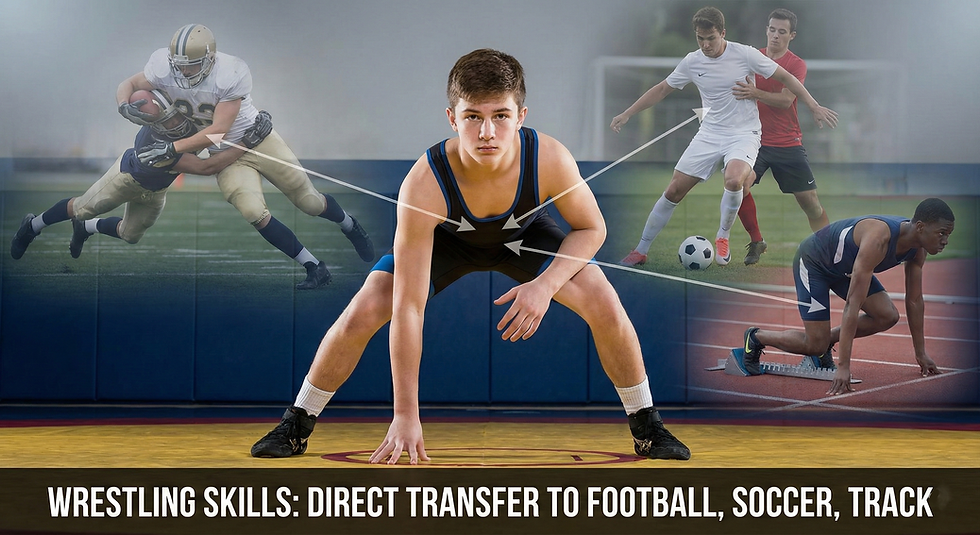
How Wrestling Helps Football, Soccer, and Track
This is where things get especially exciting for multi-sport families. The skills built in wrestling transfer directly into other sports, often in ways parents do not expect.
Football
Wrestling teaches the concept of “low man wins,” which simply means staying low and balanced. That posture helps with tackling, blocking, and staying on your feet during contact. Players who understand leverage and body positioning often feel more confident during physical plays.
Linemen especially benefit from hand control and leverage skills learned on the mat. They become more aware of where their hips and shoulders are, which improves power and stability.
Soccer
Soccer is full of shoulder-to-shoulder battles and quick changes in direction. Wrestling builds core strength and balance so kids do not fall over when bumped. It also improves coordination between the upper and lower body.
In addition, wrestling sharpens body awareness. That awareness helps players control the ball under pressure and recover quickly if they lose balance.
Track
For sprinters and jumpers, wrestling builds hip strength and posture. Strong hips and stable posture translate into stronger starts and more efficient running form. Even small improvements in coordination can make a noticeable difference in acceleration.
Distance runners also benefit. Wrestling challenges mental toughness and teaches athletes to stay composed when tired. That grit carries over into long races and tough finishes.
Across all sports, wrestling builds resilience. It teaches kids how to reset after mistakes and keep going. And that confidence does not stay on the mat. It follows them into every practice, game, and race.
Safety & Supervision
Safety is a top concern for Austin parents, and it should be. Any sport your child participates in should have clear supervision and structure. In Round Rock, parents can find programs that focus on foundational skills and confidence-building before introducing competition, which is ideal for first-time wrestlers.
Youth wrestling programs emphasize:
Proper warm-ups before physical activity
Learning how to fall safely and protect the body
Close coach supervision during drills and matches
Clean mats and consistent hygiene routines

There are no guarantees in any sport, but wrestling programs are designed carefully with age-appropriate skill development in mind. Beginners are not thrown into advanced situations. They build step by step.
If your child has medical concerns or previous injuries, it is always wise to talk with your pediatrician before starting a new activity. A good coach will welcome that conversation and work with you to support your child safely.
What to Bring
The good news is that you do not need much equipment to get started.
Start with:
Athletic shorts or sweatpants
A comfortable T-shirt
Wrestling shoes, which are helpful but not always required at first
A water bottle
Many clubs allow beginners to try a few practices before investing in gear. This makes it easy to explore without pressure.
Keep it simple. Focus on comfort. Let your child adjust before adding anything extra.
How Parents Can Help Kids Stick With It
This is where real growth often happens, not during wins, but during moments of doubt.
It is completely normal for kids to say, “I do not want to go,” after a tough practice. Learning something new can feel uncomfortable.
Instead of quitting immediately, try this approach:
Commit to four more weeks before making a final decision.
Focus on effort rather than wins or losses.
Ask, “What did you learn today?” instead of “Did you win?”
Celebrate small improvements, even if they seem minor.

Wrestling teaches resilience and character through challenge. However, kids need parents who reinforce that growth mindset at home. When you stay calm and encouraging, they learn to do the same.
Community also matters more than medals. When families connect with other wrestling parents, kids feel part of something bigger than themselves. That sense of belonging often becomes the reason they stay, and the reason they grow. Families in Buda and Kyle often choose smaller club environments where younger athletes receive more individualized coaching and close supervision.
Next Step in Austin
If you’re curious, don’t overthink it.
Find a local Austin youth wrestling program near Cedar Park, Round Rock, Leander, Buda, or Westlake/Lake Travis. Many of these Austin-area programs allow new families to observe a practice or try a trial week before committing, making it easier to explore wrestling without pressure.
Try two practices before deciding.
Then consider committing to 4 more weeks.
Give your child time to feel uncomfortable… and then proud.
Wrestling isn’t about winning at all costs. It’s about helping every kid feel strong, capable, and confident
And that confidence follows them everywhere.
FAQ SECTION
Is wrestling safe for kids?
Yes, when supervised properly. Youth wrestling emphasizes controlled movements, safe falling techniques, and close coach supervision. Like any sport, bumps happen, but safety culture is strong in well-run programs.
What age should a child start wrestling?
Many Austin programs begin around age 5 or 6. Early practices focus on balance, coordination, and fun, not competition.
Will wrestling make my child too aggressive?
No. Wrestling actually teaches control, discipline, and respect. Kids learn when to compete, and when to shake hands.
Does wrestling help with football or soccer?
Absolutely. Wrestling improves balance, leverage, body control, and mental toughness, all transferable skills.
Do I need a USA Wrestling card?
Some tournaments require membership, but many beginner practices do not. Ask your local club for specifics.
What if my child wants to quit?
That’s normal. Commit to a short trial period (like 4 weeks). Often, confidence grows right after the hardest practices. If your child decides to compete, here’s how to handle first tournament nerves in a healthy and supportive way.
About the Author:
Coach Ivan McClay is a youth wrestling coach and advocate for multi-sport athlete development in the Austin area. He is passionate about helping young wrestlers build confidence, resilience, and strong fundamentals that carry over into every part of life. Coach Ivan believes wrestling should be welcoming, positive, and growth-focused, where effort matters more than medals and every child feels proud to step on the mat.


Comments